---
title: What About Microplastics?
description: We often get asked about the risk of microplastics. Below is a summary that explains how Friendlier cups and containers fare vs traditional single use options. When it comes to coffee cups, safety is
---
[Skip to content](https://help.friendlier.com/what-about-microplastics#main-content)
[![HubSpot Knowledge Base Friendlier Icon (3).png\]](https://help.friendlier.com/hs-fs/hubfs/HubSpot%20Knowledge%20Base%20Friendlier%20Icon%20(3).png?width=40&height=40&name=HubSpot%20Knowledge%20Base%20Friendlier%20Icon%20(3).png)](https://www.friendlier.com/?hsLang=en)
Open main navigation
Close main navigation
- [Go to www.friendlier.com](https://www.friendlier.com/)
[Go to www.friendlier.com](https://www.friendlier.com/?hsLang=en)
How can we help you?
- There are no suggestions because the search field is empty.
1. [Friendlier Help Center](https://help.friendlier.com/?hsLang=en)
2. [FAQs & Troubleshooting](https://help.friendlier.com/faqs-troubleshooting?hsLang=en)
# What About Microplastics?
### Introduction
We often get asked about the risk of microplastics. Below is a summary that explains how Friendlier cups and containers fare vs traditional single use options.
### **Why Polypropylene (PP) Reusable Coffee Cups Are Safer Than Paper Cups Lined with Polyethylene (PE)**
When it comes to coffee cups, safety is just as important as sustainability. While paper cups might seem like a harmless, disposable option, they often contain hidden risks that many consumers are unaware of. The lining of these cups, typically made from polyethylene (PE), has a lower melting point than polypropylene (PP), which is commonly used in reusable coffee cups. This difference in material properties raises concerns about material stability and overall consumer safety.
### **The Issue with Paper Cups and PE Linings**
Most disposable paper coffee cups are coated with a thin layer of polyethylene (PE) to prevent leakage. While this lining serves its purpose, PE has a relatively low melting point—around 105–135°C (221–275°F). Given that coffee is often served at temperatures approaching or exceeding 90°C (194°F), prolonged exposure to heat increases the likelihood of PE degradation. This degradation can lead to the release of plastic particles into the beverage, which may impact the overall quality of the drink.
### **The Safety of Polypropylene (PP) Reusable Cups**
Polypropylene (PP), on the other hand, has a significantly higher melting point of approximately 160–170°C (320–338°F). This higher thermal resistance means that PP cups are far less likely to degrade when exposed to hot liquids, ensuring greater material stability. PP is also a widely studied material in the food industry, known for its safety and durability under heat.
### **Environmental and Practical Considerations**
Beyond safety, PP reusable cups offer environmental benefits. While paper cups are often marketed as recyclable, the PE lining makes them difficult to process in standard recycling facilities. In contrast, PP is fully recyclable and durable, making it a more sustainable long-term option. Reusing a PP cup, you reduce waste and minimize environmental impact compared to the single-use nature of paper cups. Additionally, PP cups can be used until the end of their life cycle, at which point they can be recycled, further contributing to a circular economy.
### **Conclusion**
For those concerned about both safety and sustainability, choosing polypropylene (PP) reusable coffee cups over PE-lined paper cups is a wise decision. With its higher melting point and greater stability, PP ensures a more reliable and eco-friendly option. As more consumers and businesses become aware of these benefits, making the switch to safer, reusable alternatives will be key in reducing waste and promoting sustainability.
### One Page Summary
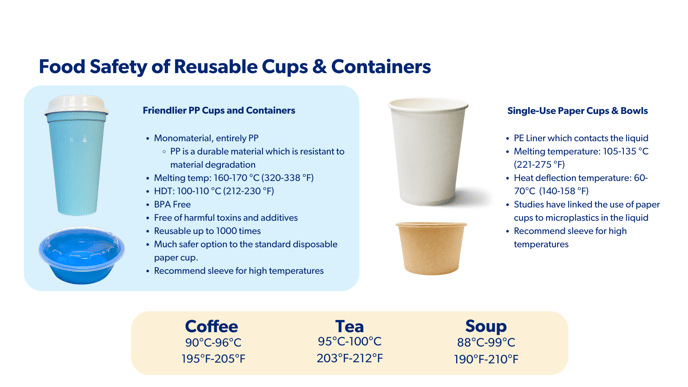
[Downloadable PDF Version](https://help.friendlier.com/hubfs/Food%20Safety%20of%20Reusable%20Cups%20(1)%20(1).pdf?hsLang=en)
- [Marketing & Communications Resources](https://help.friendlier.com/marketing-communications-resources?hsLang=en)
- [Build Awareness & Boost Engagement](https://help.friendlier.com/build-awareness-boost-engagement?hsLang=en#main-content)
- [Engagement Kits](https://help.friendlier.com/build-awareness-boost-engagement?hsLang=en#engagement-kits)
- [Catering & Events](https://help.friendlier.com/catering-events?hsLang=en)
- [FAQs & Troubleshooting](https://help.friendlier.com/faqs-troubleshooting?hsLang=en)
- [Training](https://help.friendlier.com/training?hsLang=en)
[](https://www.friendlier.com?hsLang=en)
Friendlier | 465 Clair Rd W, Guelph, Ontario N1L 1R1 | 1-844-258-3278
www.friendlier.com | info@friendlier.com
2027 © Friendlier